
Preview
For the last five years, I’ve been teaching at Bard College as professor of the arts. And each year I get to teach a total of about 24, 25, 26 students. I love the teaching process. I love getting to work with students. I love getting to show people ways to write, show them how to get deeper, how to learn. It’s an absolute delight to me.
But you don’t get to reach a lot of people. The joy of doing something like MasterClass is going, well, I can say the same things that I would say to them to millions of people because I know that there are millions of people out there who want to write because they come to me and they ask me and they tell me and they ask questions and I try and answer those questions on Tumblr, on Twitter, on my blog. But this just seems like an incredibly efficient way to just say everything that I have to say to everybody.
What I’m trying to do in this class, and I’m going to mix my metaphors outrageously here, is I want to teach you first of all how to find the tool shed. I want to take you down to the tool shed, and I want to show you some of the tools that are hanging on the walls of a writer’s tool shed. And I want to show you what that’s for and say that thing there that’s a dibber and that’s hoe and that’s a spade and that’s a shovel, and you use them all for different things.
But I also want to show you where the pitfalls are, some of the, yeah, don’t do that because if you do that, it’ll all just stop. So I want to take you into a lot of the nuts and the bolts and the hoes and the dibbers and the mousetraps and the doomsday devices, and I want to walk you through that safely and have you coming out of that gloriously garbled massive metaphor with actually a rather better idea of how to write than you had than when you started.
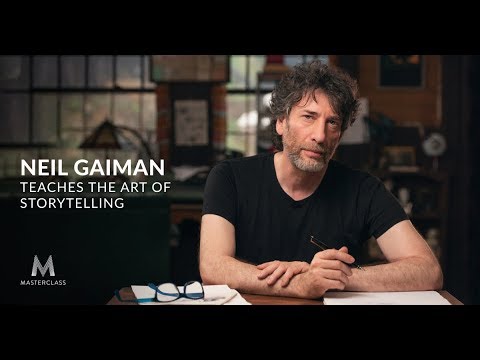
In my class, I’m going to tell you that stories are important. I’m going to tell you what stories are. And then I’m going to tell you how to build them, how to make stories, how to make stories that matter. And I’m going to give you some tips, I’m going to give you some exercises, and most of all, I’m going to give you a little push forward that you might not have had. Hello, I’m Neil Gaiman. And this is my MasterClass.
Unleash your imagination
Award-winning author Neil Gaiman has spent more than a quarter of a century crafting vivid, absorbing fiction. Now, the author of Stardust, Coraline, and The Sandman teaches his approach to imaginative storytelling in his online writing class. Learn how to find your unique voice, develop original ideas, and breathe life into your characters. Discover Neil’s philosophy on what drives a story—and open new windows to the stories inside you.
LESSON PLAN
01. Introduction
Meet your new instructor: Neil Gaiman, one of the most prolific storytellers of our time. In his first lesson, Neil explains why he loves to teach and how he wants to encourage you to tell stories that matter.
02. Truth in Fiction
One of the central tools of literature is using the “lie” of a made-up story to tell a human truth. Neil shows you how to make your story’s world—no matter how outlandish—feel real to readers.
03. Sources of Inspiration
Neil believes that even old stories can be approached from new angles. Learn how to create your own “compost heap” of inspiration and how to draw from your experiences to make a story uniquely your own.
04. Finding Your Voice
Your writer’s voice is what makes it possible for someone to pick up a page of text and recognize that you wrote it. Learn how to develop your voice and how to overcome the fear of making mistakes.
05. Developing the Story
Every story has a big idea. Learn how to find a big idea that’s meaningful to you, as well as how to create conflict and compelling stakes for your characters.
06. Story Case Study: The Graveyard Book
Neil uses his young adult fantasy novel, The Graveyard Book, to illustrate how character motivations serve as the essential building blocks of a compelling plot.
07. Short Fiction
The short story is an ideal format for risk-taking. Neil teaches you how to focus your scenes and descriptions for maximum impact.
08. Short Fiction Case Study: “March Tale”
Using “March Tale” as an example, Neil shows you how to expand your narrative by creating conflict for your protagonist and how to bring your story to a satisfying climax.
09. Dialogue and Character
Neil teaches you how to write realistic dialogue, how to listen to and trust your characters, and techniques to help readers remember your characters.
10. Character Case Study: “October Tale”
Neil explains the technique of bringing a character to life by putting them in an unfamiliar situation that creates tension.
11. Worldbuilding
Learn Neil’s philosophy of worldbuilding, including how to create compelling and believable settings for your novel, and how to avoid the common pitfalls many inexperienced writers make.
12. Descriptions
Neil shares his techniques to liven up descriptive prose, including cold opens, withholding information, finding emotional weight, and choosing memorable details.
13. Humor
Neil shows how he uses humor in his work. He includes a close look at his novel Anansi Boys to illustrate his personal techniques such as “sherbet lemons” and “figgins.”
14. Genre
Readers’ expectations are intrinsically tied to genre. Neil explains how an understanding of your story’s genre can help you provide delightful surprises to your audience.
15. Comics
Writers don’t need to shy away from comics just because they’re not illustrators. Neil demonstrates his process of plotting and scripting a comic, using an award-winning issue of Sandman as an example.
16. Dealing With Writer’s Block
Every writer faces times when they’re stuck. Neil talks about some of the difficulties of the writing life and gives ideas about how to get through them.
17. Editing
Neil gives advice about the editing process, including why it’s important to take time away from a project and to get feedback from a trusted reader.
18. Rules for Writers
In his rules for writers, Neil talks about striking the right balance between humility and confidence, as well as the need to stay organized and devoted to daily work.
19. The Writer’s Responsibilities
Neil concludes with a deeply personal discussion of the responsibilities that people who create art have to their audience and what this means for humans as a whole.
Sales Page:_https://www.masterclass.com/classes/neil-gaiman-teaches-the-art-of-storytelling



Reviews
There are no reviews yet.