
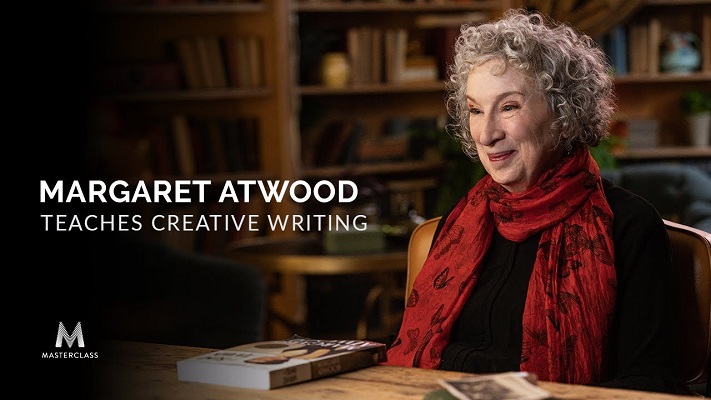
Preview
Creativity is one of the essential things about being human. You don’t have to apologize for it. It’s something human beings do. Sometimes people say, express yourself. I don’t really think that that’s necessarily the key thing. Expressing yourself can be shouting in a field. So rather than expressing yourself, why don’t you think in terms of evoking, conjuring up for the reader some curiosity, some suspense, some interest rather than this is my ego?
[CLASSICAL MUSIC PLAYING]
If you’re a writer, you have a very limited repertoire of tools. Your repertoire is a blank page and some words that you put on it. So you’re not making a film. You don’t have sound effects. You don’t have actors. You only have those words that the reader is reading. And that’s what you use to build everything in your story as words.
Words on a page are inert. They’re like black musical notes on a score. They’re inert until the music is played, or in the case of a book, the reader is reading. And when the reader is reading, the words transform back into representations, sounds, smells, colors, people.
Reading is the most participative of the arts. There’s more brain activity when you’re reading that kind of intense text than there is, for instance, when you’re watching television, when you’re watching film, because the brain has to supply everything with the words used just as cues, clues. So what you’re providing the reader with is a score, a score that the reader will then interpret. And all you can do as a writer is make your book as good as it can be. You throw it out into the world, hope for the best. And that’s all you can do.
You can not dictate to the reader how they should read your book or receive your book. Because the meaning of a book, once it’s is out in the world, is not decided by the writer anymore. Even if the writer has thought the writer was putting x meaning into the book, the reader may have quite a different idea, and usually does over time. So Thomas Hardy thought that “Tess of the D’urbervilles” was about the irony of fate, and we think it’s a pretty kinky story about what happened to women in the Victorian period. I mean, that’s what I think. What do you think?
When I wrote “The Handmaid’s Tale,” I didn’t give the central character a name. The readers decided that her name was June. There’s nothing in the book that contradicts that. In fact, it all fits. But it wasn’t something I thought up. The readers figured it out. It has to be June once you come to think of it, because each of the names that are mentioned in chapter 1, they all occur again in the book except for June. I thought that was pretty smart of them.
I’m Margaret Atwood, and this is my MasterClass.
The art of powerful storytelling
Called the “Prophet of Dystopia,” Margaret Atwood is one of the most influential literary voices of our generation. In her first-ever online writing class, the author of The Handmaid’s Tale teaches how she crafts compelling stories, from historical to speculative fiction, that remain timeless and relevant. Explore Margaret’s creative process for developing ideas into novels with strong structures and nuanced characters.
LESSON PLAN
01. Introduction
Meet your new instructor: Man Booker Prize-winning author Margaret Atwood. In your first lesson, Margaret shares her perspective on the art of writing and who ultimately gives your book its meaning.
02. Getting Started as a Writer
Margaret encourages you to find your own path, overcome obstacles like fear, and start writing by sharing her own writer’s story and creative process.
03. Story and Plot
Learn what makes a strong plot. Margaret advises you to study myths, fairy tales, and other historical works of literature so that you can use them as building blocks for your stories.
04. Structuring Your Novel: Layered Narratives and Other Variations
Margaret illustrates the myriad ways you can structure your story and create a multi-layered narrative, using the classic tales Little Red Riding Hood, Arabian Nights, and her own novel The Blind Assassin as examples.
05. Who Tells the Story: Narrative Point of View
Choosing the right point of view to tell your story from involves a lot of trial and error. Margaret explains the impact this decision has on your story, and offers an exercise to help you explore the effects of various points of view.
06. Point of View Case Studies
In this chapter, Margaret discusses her use of multiple points of view in Alias Grace, and why she wrote The Handmaid’s Tale from the first person point of view.
07. Bringing Characters to Life Through Detail
Actions and reactions reveal character, but so do details the writer thoughtfully weaves into the story. Margaret offers concrete tools to help you create nuanced, well-developed characters you know by heart.
08. Creating Compelling Characters
Margaret teaches why the most compelling characters are often not very likeable, and delves into how gender plays into our expectations about character.
09. Writing Through Roadblocks
Learn Margaret’s advice for overcoming challenges such as constant interruption, writer’s block, or a narrative problem you can’t figure out how to solve.
10. Crafting Dialogue
Margaret teaches how to use dialogue to reveal character and story, and discusses the importance of making your dialogue authentic to the time and place in which your narrative transpires.
11. Revealing the World Through Sensory Imagery
The more specific your details, the more engaged your readers. Learn how Margaret uses The Handmaid’s Tale to illustrate her approach to imagery.
12. Prose Style and Texture
Learn the difference between style and description as Margaret illustrates two different prose style extremes—baroque and plainsong.
13. Working With Time in Fiction
Margaret explains the significance of time in fiction, and offers advice on keeping readers oriented without compromising your story structure.
14. The Door to Your Book: The Importance of the First Five Pages
From Melville to Dickens, Margaret shares some of her favorite opening lines and underscores the value of making your first five pages utterly compelling.
15. Writing the Middle and Ending
Margaret teaches her approach to keeping readers engaged through the middle of your book and discusses the merits of closed and open endings to your story.
16. Revision: Seeing Your Work Anew
For Margaret, revision is an opportunity to take a fresh look at your book and consider new possibilities. Learn the value of soliciting feedback from select readers, and the importance of a good line editor.
17. The Novel and the Shifting Sands of Genre
Margaret discusses the evolution of the novel and asserts that the writer’s objective should be to stay true to the foundational elements of storytelling, regardless of genre.
18. Speculative Fiction
Learn Margaret’s approach to writing speculative fiction and her advice on how to generate ideas and build your world in this genre.
19. Speculative Fiction Case Study: The Handmaid’s Tale
Margaret reveals the ideas and research that inspired The Handmaid’s Tale, offering a first-hand look at some of these materials.
20. Research and Historical Accuracy
Getting details right is critical in historical fiction and can lend believability to any story. Margaret emphasizes this point but also shows how to avoid letting research slow you down.
21. The Writer’s Path
Margaret reveals the one book she recommends to all writers, and shares inspirational stories from writers past and present to encourage you to persevere despite the obstacles you may confront.
22. The Business of Being a Writer
From finding an agent, to getting published, and dealing with negative reviews, Margaret offers her perspective on the business of being a writer.
23. Parting Words
Margaret bids her students farewell, sharing her desire to pass on her wisdom to the next generation of writers.
Sales Page:_https://www.masterclass.com/classes/margaret-atwood-teaches-creative-writing


Reviews
There are no reviews yet.