
Preview
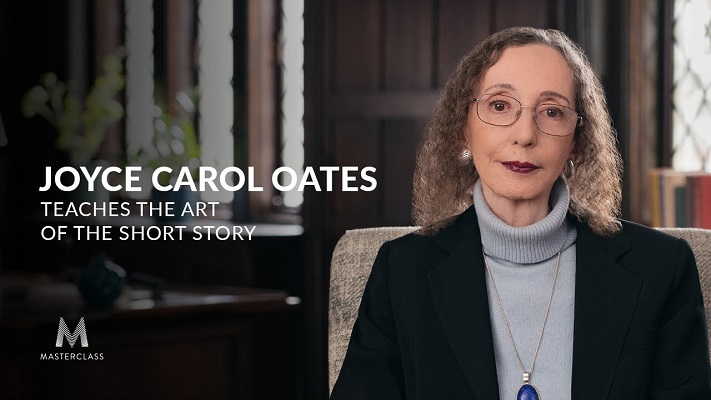
[MUSIC PLAYING] JOYCE CAROL OATES: I’ve always felt that art is the highest expression of the human spirit, and art is the way that we communicate with one another. But that instinct to transcend the particular and the finite and to reach for something universal– that speaks to people across generations. I think that is the instinct for all kinds of art.
But I think a born writer wants to tell a story, and that instinct to tell stories is very natural. All you need to do, really, is to take their instrument and transform it into a craft. So if anyone who’s listening to me feels that he or she is a writer, you probably are.
[MUSIC PLAYING]
This class is not– not about theory or philosophical background so much as it is about the craft of writing and– and getting you habituated to writing because we all have stories to tell, but some people just don’t have the form quite yet. The MasterClass follows the outline of my class– my undergraduate fiction-writing class at Princeton University. So I’ve been teaching there for many years, and it’s the same syllabus that we go through, like 12, 15 weeks, with the short assignments– beginning with really short paragraph– page, two pages. So it’s basically working with telling stories, which is my anthology, which is for writers, because when you’re a writer, you’re not reading just for pleasure. You’re reading as a writer, so you have a special eye for prose.
I have a great love for fiction, which I hope I can share with– with you. And we’re going to begin with shorter forms. And we’re going to be focusing on just the act of writing– the short narrative can be like one paragraph long– and move into writing as you might move into a fast-moving river, where you’re just take a little step at first, then another step, and another step. And you get acclimated to what you’re doing, and get to love writing, and– and feel– always, you should be having a good time writing. As time goes on, you may take on more complicated projects, but in the beginning, the assignments are very short. And you may even be working in fields like memoir, or journal, and diary that are not necessarily fiction, but your use for fiction.
Writing is a process. At the end, there may be a product. There may be a book or a story. That’s the product. But you are living in the process. And the product is what is in the future. But a short story is– is the best form for starting off.
I’m Joyce Carol Oates, and this is my MasterClass.
[MUSIC PLAYING]
Find your voice in fiction
The author of some of the most enduring fiction of our time, Joyce Carol Oates has published 58 novels and thousands of short stories, essays, and articles. Now the award-winning author and Princeton University creative writing professor teaches you how to tap into your storytelling instincts. Find ideas from your own experiences and perceptions, experiment with structure, and improve your craft, one sentence at a time.
LESSON PLAN
01. Introduction
Meet your new instructor: Joyce Carol Oates, the National Book Award–winning author of 58 novels and thousands of short stories. Joyce welcomes you and discusses the enduring importance of short fiction.
02. Principles of Writing Short Fiction
You want to write. When and how do you get it done? Joyce explains how to draft, revise, and share your work with others. She also touches on rejection and how to protect your time for writing.
03. Journals: Observing the World
Journaling is a tried-and-true method for self-expression and discovering your voice. For illustration, Joyce reads from one of Virginia Woolf’s diary entries.
04. Ideas: Exploring Taboo and Darkness
Joyce discusses how delving into the darker elements of your personality and past can provide compelling, heartfelt fodder for fiction—as well as a means to finding a unique audience.
05. Structure and Form
Some of Joyce’s experimental approaches to structure include considering the shape of a story on its first page and writing a one-sided dialogue. She reads from her story “Heat.”
06. Ideas: Writing the Familiar
Your past and your family can be a rich trove of story material. Joyce walks you through examining childhood influences, interviewing family, and remembering physical places that have left a lasting impression on you.
07. Form Study: Miniature Narrative
Joyce analyzes very brief narratives—ones with no more than a few pages—for the language and structure they require. As an example, she reads from the William Carlos Williams story “The Use of Force.”
08. Form Study: Short Monologue
Writing a monologue can be a useful stepping-stone to crafting a novel, as well as a good exercise in exploring the perspectives of characters unlike yourself. Joyce’s monologue story “Lethal” serves as an illustration.
09. Story Study: “Where Are You Going, Where Have You Been?”
Joyce reveals what inspired—and how she wrote—her most well-known and reprinted story, including how she chose the main character’s perspective and how adjusting perspective can be helpful for your own story.
10. Reading and Studying Writing
How do you read with the intention of finding new ideas and learning from writers you admire? Joyce leads a discussion on reading as a writer.
11. The Writer’s Workshop: “Indian Camp”
Joyce and two of her students—Lindsey Skillen and Corey Arnold—read from Ernest Hemingway’s story “Indian Camp.” They review the work as they would in one of Joyce’s collegiate or graduate classes.
12. Revision Workshop: “Labor Day”
Joyce holds a workshop of her student Lindsey’s story “Labor Day,” which can be downloaded in advance of the lesson.
13. Revision Workshop: “Near Death”
This workshop focuses on Corey’s short story “Near Death,” which can also be downloaded in advance.
14. Closing
Joyce shares her parting words, advising how to select a place to write that makes you feel inspired and how to continue finding joy in the writing process.
Sales Page:_https://www.masterclass.com/classes/joyce-carol-oates-teaches-the-art-of-the-short-story

Reviews
There are no reviews yet.